Sunday, April 24, 2022

SCREEN SHOT - The Human Voice


Look, its half an hour long. Half an hour of the divine Tilda doing her stuff. Plus, its directed by Pedro Almodovar. Plus, its Tilda doing her stuff for half an hour. What are you waiting for? Just watch it, right now! 

Originally a stage play by Jean Cocteau. Almodovar has transformed it into something flamboyantly all his own. He built the set inside a warehouse, to emphasise the contrived aesthetic of it still more. Every aspect of the flat is designed to the absolute hilt, both stylish and stylised, every decor choice strikingly distinctive. Each shot in the movie composed in strong colour blocks of primary and secondary colours, placed against the softer green wall colouring.


Living within the artifice of this oh so beautiful environment is an equally immaculately dressed woman. She's waiting, waiting for the man with whom she created and once shared this ultra luxurious flat. Her former lover, he still hasn't come to collect his bags and belongings. They are waiting in the lobby. She is waiting for this return, or at least a call.

The woman will break out of this staged set. Pacing back and forth, as if stalking the warehouse, dressed in a bright scarlet ball gown. The woman's life appears completely dictated by the constraints of high fashion, a high maintenance lifestyle and appearance. And yet now her life and this lifestyle is upturned, she cannot move on nor escape from it. She's still holding out for the man to return. Until she can speak to him, her life is kept on hold. The man appears to be deliberately keeping out of contact. His silence is an expression of his power over her. Then the man does phone. 

Tilda Swinton, conveys all the brittle nervy desperation of this woman. The transparency of her lies and deceptions, to herself and others. How emotionally dependent she remains on this man, it hurts. Yet, as the call progresses, there is a gradual realisation that she can recover agency over her life and future.  There is, after all, something she can do to break the spell to release herself from this gorgeous prison.

Its just brilliant, watch it.


CARROT REVIEW 7/8


Currently available on I Player.

Friday, April 22, 2022

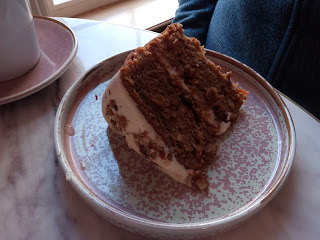
CARROT CAKE REVIEW No 31 - Claggy as in Cement

 Sheringham, Norfolk


Cafés in our town are ten a penny, really good ones are a rare species. Most are not bad. Pleasant, but average you might say. Nothing to, scare the horses by producing a well rounded Flat White with great richness and depth. Buying a coffee here generally blurs the boundary between a cappuccino and a latte, whatever the coffee variety actually be being made. This, in my experience, is not unique to this town.

Suddenly, post pandemic, cafes in North Norfolk seem to have woken up to the fact that they are competing for business. Standards of confectionery have noticeably risen. The coffee quality has yet to follow suit. I do like this particular cafe, its very pretty, always has a welcoming feel and good customer service. Their coffee? Well let's just say three things - One, their Latte's are good. Two, their Flat White's come in two sizes Regular and Large. Three, their Latte's are good.

Its a universal truth that any shop has its set of Unique Selling Points, and the things that it regularly falls down on. Here its homely, friendly ambiance and customer service do much of the heavy lifting, to makes it an very attractive place for a return visit. Which we do, when we can. The coffee quality as I've said, is acceptable. The Cakes? Well it depends what you choose. Their quality can vary from great, to nice try, to that's a bit under cooked. But that is also quite a common fault in cafés. One can also unwittingly find oneself eating something made for sensitive stomachs without fully knowing it. Left  wondering what it was that was not quite perfect about that red velvet muffin.

But they did have a Carrot Cake on this occasion, so I showed myself willing to give it a try. I ordered my Large Flat White in the full knowledge that it would only be a strong Latte. For that was my subversive desire. The cake, well it had a good enough golden tan like appearance, a slightly feeble looking buttercream, and a texture of woven strands reminiscent of OSB board. So the visual impression was of a pleasant enough facsimile of a carrot cake. But as with all things, looks can be god almighty fibs.

As I put the cake in my mouth I was a little on edge about how it would be as a taste experience. Initially it was OK, yes, this was OK, wasn't it? As my taste buds got used to the new sensory sensations and began to interpret them, there was an odd transition in its texture. Rather than holding its weight and flavour, once saliva got to work on it, the texture dissolved into a claggy, then almost dry cement like after taste sensation. I recognise this. Oh, you all know what this is, don't you? This is some aberrant variety of gluten free flour unlikely to send anyone's stomach into a full disgruntled bloat. Give me strength my great Jehovah!

You know, I'm becoming tired, yes, really tired of the increasing pervasiveness of these sort of culinary subterfuges. Bakers are noticeable getting better at producing gluten/dairy free cakes that look convincing from the outside. But the taste experience still leaves me half aggravated, half disappointed. Too exhausted now for the full on fulminating rant.  

I like this cafe a lot, but its not because its an all round superlative experience. It can be patchy. But then when is any café ever such a thing? Not very often I would say. I can remember a handful, no, its less than a handful, of truly all round brilliant cafés. My expectations are always for something that is actually a very very rare occurrence. Where ambiance, customer service, coffee and cake quality all reach a peak of excellence. And that can be even harder to maintain.

But, please, please please, out of genuine concern for my continued mental health, could I be told when a carrot cake is made with gluten free flour and maybe I'll chose a bloody half macerated flapjack instead. Because I'm just so so so tired of the failed fakery of gluten free carrot cakes that would not upstage a Farley's baby rusk.

CARROT REVIEW - 3/8


Wednesday, April 20, 2022

THE BEST BEFORE DATE - 1978 - Duck Stab by The Residents


Duck Stab was my first entry point into the rather deliberately bizzare and unconventional aesthetic of The Residents. At the time, in 1978, The Residents were an ultra secretive avant garde art and music collective working out of California. Little was then known about them as individuals. No names other than that of their frequent guitarist of choice Snakefinger.  After 60 albums and fifty years of existence some of them have now been named, outed as being members. Despite vociferous denials! 

Their early work consisted of surreal and frequently discordant parodies of pop classics and rock conventions such as their version of The Rolling Stone's Satisfaction, or on albums like - Meet The Residents, Third Reich & Roll. My personal favourite is The Commercial Album, which has forty tracks of each a minute in length. Its a beautifully executed exercise in the concise use of sound and style to instantly create a mood. On these, rock instrumentation and synths are sometimes subversively played on massively amplified children's musical toys. The vocals distorted in a way that makes them sound sinister, twisted, unnervingly sounding as if The Muppets were crazed on amphetamine. The lyrics mimic the style of children's nursery rhymes but are as if by a chorus of demented clowns. Where - an ether eating eskimo would gag upon the sight. Convulsed into oblivion from laughter or from fright. Yeah, weird man.

The original Duck Stab was an EP, which has since been expanded to LP length by including another EP - Buster & Glenn. But there was something about the economy and brevity of Duck Stab, with its seven tracks in just over sixteen minutes. Just enough weirdness without it becoming unrelentingly jarring or tiresome. Some tracks have a distinctly unsettling air - Sinister Exaggerator  & Blue Rosebuds, others are playfully deranged fun - Laughing Song  & Bach is Dead. The track listing goes as follows:-

Constantinople
Sinister Exaggerator
The Booker Tease
Blue Rosebuds
Laughing Song
Bach is Dead
Elvis & his Boss

Worth searching out are a few concept albums such as Eskimo, basically a parody of Eskimo life and rituals, or The Mole Trilogy a narrative tale about a conflict between the Moles and the Chubs. These were quite conscious attempts at the time by the group to break out of their well known and loved form as rock n roll wackos. After these albums I sort of lost interest in them and moved on to some other trashy pop art darlings.


Friday, April 15, 2022

SHERINGHAM DIARY No 60 - The Twin Mountains of Expectation & Prevarication


It is true that when you long for something to arrive, time actually extends. Its a bit like Pinocchio's nose getting longer the more he lies. Any event seeming further away, even as it paradoxically is actually getting nearer. The effect of our desires, the longings, the expectations appears to slow the experience and acceleration of time, putting the brake on how our lives are progressing. Expectation freeze frames the sense of forward motion.

As I've mentioned before, post Christmas trade in Sheringham is always dire. However,having no experience of March before, we naively expected trade to start picking up. But despite our neighbours in The Courtyard repeatedly telling us its always pants, we clung to our hopes that for us it might be different. It wasn't. Also the constant news about hard times and income squeezes to come, gave our confidence a shake. What effect will all this have on the tourist season? Everyone talks of how things don't really pick up till Easter. But will it this time.? Easter is also late, it seems an age away. We've bought in new stock lines in readiness. Let the season begin ....soonish.

If our experience of the last three months has felt harder than before, this is partly of our own making. What helps a bit, is if I practice cultivating a hopeful demeanor, unattached to any specific outcome. Trust in days being whatever they will be. Observe how they sometimes will turn around from dire, to fine, to flush. All this will happen inspite of my wishes and longings. So I try to minimise wishful thinking, speculation and expectation. To paraphrase the Indian teacher Sadguru, there is only the present moment where you can have any effect on what happens, so focus on that, keep plugging away putting energy and initiative into it. Remaining unattached to any desired for result.


Soon enough the bunnies of Easter will be seen bounding over the fields with their bountiful baskets full of eggs. From the moment April arrived things did indeed begin to pick up. The sales pattern of each day is erratic and unpredictable,though takings prove steady in the end. We have found that the number of sales has gone up, though the average sale figure has dropped by about a third. So this coming season, it seems, will require us to keep pace with the increased turnover on smaller priced items. Simply matching last year may be harder to achieve, but not necessarily impossible. We wont have our first real indication until the end of this month where we might be with it all. But people are certainly being price conscious, purchases are taking more consideration. Increasingly folk are paying in cash, which usually means they are carefully managing their spending.


In June this year it will be four years since I resigned from the Triratna Order.  This has of course removed me from close association with that Sangha, from the network of friendship I'd built up over my years of involvement. Subsequently trying to find a new Buddhist Sangha to join, proved to be like putting the cart before the horse. An atmosphere of aloneness inhabits the individual spiritual path, it's one of its particular qualities and one could say a down side. 

Independence rarely exists in a pure state, its neither entirely 'free from' nor entirely 'part of'. In the same way, a country cannot be wholly an independent sovereign entity. In the interaction of trade and culture we choose to relax the degree and scope of our independent activity. Countries agree to collaborate wherever it becomes mutually advantageous to do so. Likewise for me, if there is a middle way here spiritually speaking between independence and belonging, it's in the area of 'freely associating' 

So, because I remembered with fondness doing meditation and morning service regularly I've returned to attending them a few times a week via Zoom at Norwich Zen Priory. It is just for that. I'm not committing fully to their approach. Its simply their morning service still speaks to me. It sustains me in some way, perhaps it helps to touch base with this regular morning meditation Sangha. To feel less cut off on this path of spiritual exploration I'm on. Even though that is in reality how it actually is.

Jnanasalin and I recently spent a delightful day in Bury St Edmund's with Taradasa and Vidyasiddhi two friends of ours from Cambridge. Last week Saddharaja and Saddhahadaya were up here in holiday and came round for dinner. Saddharaja is a friend whom I've known the longest in Triratna, and I always enjoy his company, shared enthusiasms and his encouraging presence. Each experience was delightful and invigorating. They lifted my spirits, but this also reminded me what was currently in short supply.

Jnanasalin and I make a good team and effectively support each other. Though we know we each have our limitations. Everyone needs a broader supportive network if only for the benefit of a different quality, tone or perspective to the conversations. Jnanasalin is still part of the Order so he still has that context outside of just the two of us. I've had moments over the Winter of feeling the lack of friendship here quite keenly. 

Not a naturally gregarious person, I'm the classic introvert in many ways. Friendship doesn't come easy.  I tend to be initially wary in new contexts. Opening up and relaxing more once I feel at home and welcome. An aim for this year is to start making connections outside of the shop context. To find groups in my area I'd feel happy to join and be a part of. I have some ideas, its just getting around to acting on them. There are the mountains of prevarication to overcome. Well little mossy hillocks really.


I continue to work, admittedly somewhat erratically, on my shrine to Our Lady of Walsingham. I'm nearing completion of the external structure. So I will have to start settling soon on the form for its interior. What is that going to be like? I'm loving the shade of blue I"ve used for the exterior. The shape of the shrine is reminiscent of Anglo Saxon caskets. Which is very apt as the original shrine was a small rectangular chapel built by an Anglo Saxon noblewoman in response to a vision she had. 


My vision for the interior keeps changing from day to day. My uncertainty is making me prevaricate starting on it. But like the exterior I just need to begin doing something, then the ideas and direction will evolve out of that. That's the problem with both expectations and prevarication, they both tend to inhibit action being taken, yet that is the very thing that will overcome them.


Wednesday, April 13, 2022

BROTHER DAVID ON - The Mystic


' The mystic is not a special kind of human being.

But every human being is a special kind of mystic.'


Brother David Steindl-Rast

Tuesday, April 12, 2022

SCREEN SHOT - Lawrence of Arabia


This David Lean film, originally released in 1967, is the classic heroic epic film. Redefining at the time what that could be. The filming constantly astonishes you with its beautiful framing and composition. It is always worthy seeing this on a huge cinema screening, seize it should you ever get the opportunity.

T E Lawrence gets sent to Arabia purely on an information gathering assignment. But in the desert tribes he finds his real vocation, his cause in life, and returns to Cairo an unlikely hero.  Its hard to separate fact from myth these days. Having tried to read Lawrence's Seven Pillars of Wisdom twice, and failed both times. I can confidently assure you he was a truly awful and turgid writer. Lean's film does show how the Lawrence myth started, how it helped and hindered the man himself.

Peter O'Toole plays Lawrence with all the charisma and sensitivity he can muster. For which he was rightly nominated for an Oscar. Some of the casting of Antony Quinn and Alec Guineas as Arabs certainly would not happen these days. But I have to say it still works because both are skilled actors. It ought to creak more, but somehow doesn't. Guinness, playing an Indian in a Merchant Ivory film twenty years later, felt considerably more ill considered and offensive.

The script hardly misses a mark showing you how Lawrence's ideal of a free Arabia, got betrayed by the secret Sykes Picot agreement. How he moves from being a man revolted by killing to one who madly revels in it. From someone who plays along with his image to someone who believes in it as his destiny, and becomes trapped within his own myth making. He is a heroic figure, but we are allowed to see the shadow side of his personal failings too. Had he not died in a motor bike accident at the age of 46, one wonders quite how perceptions of him might now have changed.

CARROT REVIEW - 7/8


Monday, April 11, 2022

THE BEST BEFORE DATE - 1982 - Klacktoveedestein by Blue Rondo a la Turk


Some bands find their moment, whilst others such as Blue Rondo a la Turk try to create their own moment and never quite make it happen. At the time, 1982, their mix of salsa, pop and soft jazz stylings was on the verge of becoming incredibly trendy and in vogue. With zoot suits, padded shoulders and slicked back hair, everything looked at the time ripe for Blue Rondo a la Turk. Word of mouth was building, press reviews of their live gigs raved. But when their sound reached the vinyl something seemed to fall distinctly flat upon the ears. Where was all that pizzazz and verve we were expecting to hear?

Their first single Me and Mr Sanchez reached only the lower end of the chart at 40. The second, this track Klacktoveesedstein, even though it was produced by Godley & Creme, faired little better topping out at 50. But it showed more of their promise, that 'uh uh uh ah' vocal backing is the real making of it. Lifting it a bit beyond your average Latin tinged derivative. I still have a soft spot for it all these years later. 

Blue Rondo a la Turk didn't last much longer. The record company brought in some big hitters to try and salvage their speculative investment. But their second album, part written and produced by Clive Langer, ex Deaf School and Madness producer failed to chart. Two of them split off to form Matt Bianco, who did have a moment and a few Latin tinged hits. The lead singer Chris Sullivan ran The Wag Club for a while, started making videos and eventually became a successful writer.

Friday, April 08, 2022

MY OWN WALKING - Journal March/April 2022

I've been making a practice, a somewhat irregular one, of taking time to write down things I'm grateful for. Each time when I open my notebook and write down my impressions, I'm aware that in this process what is noted is not always gratitude. It maybe on the path to gratefulness, but it has a way to go before actually touching it. This has started a reflection for me about what the relationship between appreciation and gratefulness is. There obviously is one. Appreciation is an observation, containing an emotional response that sometimes results in gratefulness. But a lot of the time it remains just appreciative.

Brother David talks about the element of surprise in gratefulness. You become a aware, as if for the first time, of a feeling, impression, thought, action or a person. The effect upon you of that given moment is that it takes you by surprise, startles your five senses unexpectedly.  Suddenly you appreciate your life or experience in a different way. As though what was once monochrome is now coloured. The consequence is that you may stay with that moment, until you no longer can, and then bask in remembering your appreciation. Feeling a grateful uplift that it exists.

Appreciation contains the potential to love what is present, or recently passed from your experience. To love it wholeheartedly and unconditionally. And in what we are aware of, appreciate and love we find the foundation of gratefulness. There is always the tendency in the remembering of appreciation and love, for it to be overcome by sentiment and nostalgia. To slip into desire and not gratefulness. Gratefulness seems strongly related to any given moment. Each instance if it will be lost. Once we look back, longing for that moment to return, our grip on gratitude slips.

To feel grateful for an experience, is to appreciate and love what appears in each given moment. Simply for existing. For being just as it is. Its value is in its impermanence, that it will disappear. This is all part of why we feel grateful for something existing at all. For it is transient. Each moment of gratefulness is special. It is unique. True gratefulness appears not to cling. It immediately has to be let go of.

All this runs counter to some of my habitual feelings and responses. On some days I'll place a qualification, a but, a negative coda following after any expression of gratefulness. As if this is required for authentic truthfulness. The nature of any practice is that it feels inauthentic at first. For it will be. Gratefulness is being faked. You will feel a fraud, and that is OK. I'm playing let's pretend, until at some point may be I am not. 

The practice is to tune into a different way of appreciating experience. To change the habits of a lifetime rarely happens overnight. Becoming more appreciative is a huge step in the direction of gratefulness. Even thought it may not yet be grateful appreciation. Like a novice archer, its all about the practise and perfection of your aim.

I'm becoming more aware that gratefulness, when you do feel it, needs to find its own particular form of expression. There is an imperative, an impulse within gratefulness that demands it should be spoken, expressed through action. What is the medium or voice for this?  It may not be truly gratefulness unless you do. Gratefulness at heart is about an expressed connection, of a love for a love.


Thursday, April 07, 2022

POEM - What is being left unsaid?

In the stream of words
they come at you, like tart veins
of raspberry fluid mixed into the iced cream
of form, context and meaning, all
lost to the tone, the frustration
that's weighing down the words,
we feel it, but reluctant to hear the phrasings,
lest there
being used as smuggler ships,
bringing in the contraband
of unacceptable thoughts, the ballast of prejudices,
the half formed, dressed in not quite ideal language
words isolated from sound, unmoderated
unmodulated, unmediated, unmasked
mouths we don't like the shape of, from people 
with human hearts and lungs, articulating
in inarticulate ways, do we fear some sharp needle
is concealed within these raw dum words?
not used in circles, elliptic or squared off
directed words, pointed and pointing, 
clumsy exclamations, maybe
symptoms of their voicelessness,
echoing around a dead end canyon far far away, away, away,
from rooms where 
you just don't say that, shut up, you and your sort
back to your sleepy silent hollow, diverting you from the 
stream of discourse, the artificial seating arrangements
of polarised debates, intellectual nuance built in
to silence anyone unversed, take away 
the embrasure of their mouth,
their oxygen, their ability to breath,
dialogue with their diaphragm
and release, exhale those befouling words into a megaphone
and the reports will edit it out, yet if there are
no pictures, no texts, no blog posts, no vapour trails
then history becomes neglectful, an impoverished lie
presenting only neatly packaged myths
sanitary words, binding nuptial agreements
speech, truly free, cannot be legislated for
it abhors the stamp of government
approval, we must be willing to suffer the coarse in words,
the sling of uncomfortable sentences
their lies, their truths, their defencelessness, their innocence
of the narrative, how stumbling they can be,
off message mouths, test our shibboleths
are the imperfect vehicles for the collective brain, there's pain
in the named storm of these words, this is how language 
is cracked open,
to examine the oracles displayed in its entrails, 
and then to discourse
for this is all we can do, to locate
whether there is any truth
in whatever is being left unsaid.


Stephen Lumb
written March/April 2022


Sunday, April 03, 2022

THE BEST BEFORE DATE - 1977 - R.A.F. by Brian Eno & Snatch


Here we are, its 1977, and a B side to Eno's single Kings Lead Hat, providing an really interesting curio from Eno's extensive back catalogue. Its an early instance of the use of 'found verbal conversational sound' in his work. At a time when he was bored with the timbre and limitations of his own singing voice, and began exploring using 'found' sources as a way to create a different type of vocal presence. An idea further expanded upon in My Life in the Bush of Ghosts with David Byrne in 1981. Holgar Czukay's seminal album, also built around edited short wave radio recordings of found voices - Movies - was not released until 1979. Though in 1977  it was already in its long gestation phase, an idea still in the process of being worked out. 

Found verbal conversational extracts were on the brink of having their moment in popular music. Other ideas such as scratching and sampling would also emerge into the mainstream over the next five years or so. Though 'found sound', was not in itself new, The Beatles had used it, and it had been around in contemporary music and avant garde circles for literally decades, since the widespread availability of tape recorders. Then a new tool to colour soundscapes with. The arrival of the first widely available home computers in 1977 would eventually bring a whole new way of composing music into being. One that took this idea of 'found' musical sources onto an entirely new level. 

But here we have R.A F. a three minute music sound collage utilising edited fragments of recordings made of the left wing militant The Red Army Faction, a splinter group off the Baader-Meinhof Group. They were reportedly directly responsible for 34 deaths, but even more if one accounts for those collaterally damaged. The recordings used here were made during the kidnap of the banker Hanns Martin Schleyer, held prisoner and ransom money demanded. They would eventually murder him. 

Snatch, were Patti Palladin and Judy Nylon, who moved to London in 1974 to be a part of the London punk scene. Their music had a punk stroppiness and was edgy, like Lydia Lunch crossed with Lou Reed, generally documenting aspects of urban low life. Here they are the muttering voices 'do you think anyone's worried about you?'and the final defiant salute of 'No Sacrifice!. 

The music is layered with numerous Enoesque sound treatments of instruments, all wack a wack dub looped bass, a discordant jangly guitar sound that goes in and out throughout the track like a drone. Plus an incredibly hard as concrete drum sound, really cutting,with the flattest of punches to its snare. Previously heard on Bowie's Low, made in collaboration with Eno, and released the same year as this. Together this conjures a very urban and hostile soundscape into which the German words of the R.A.F. menacingly crackles and weaves. A whole world away from the lyrical word play and musical mischief of Eno on Seven Deadly Finns, three years previous. 

R.A.F. - a perfect pop record? Well, no, but certainly one of Eno's finest moments and a brilliantly complex reflection of its time.

SCREEN SHOT - Drive My Car


Yosuke Kafuko is living a happy and creative life with his wife Oto. He a successful actor and director, she a brilliant screenwriter. Whilst journeying in their car, during or after sex, she spins elaborate and bizzarely dreamlike tales. Yet there is much that remains unspoken, particularly of Oto's regular extra marital affairs. He knows when these are happening but never says anything, he is so afraid of losing her. On the night he thinks they are going to finally broach the subject, he returns to find her unconscious, she later dies.

Three years later Kafuko is a director in residence, assembling a cast for a production of Chekhov's Uncle Vanja. He chooses Takatsuki to play the lead, because he recognises him as Oto's final lover. He wants to understand why Oto needed these affairs, what they gave her that he could not. But its too late now, isn't it? Coming with this job is his very own driver, Misaki Watari, she is very skilled at her job and a good listener. On their daily car journeys they reveal more and more to each other. Discovering they have a lot in common, for each holds a secret guilt.

Based on a Haruki Murakami short story from his collection Men without Women. The film bears some of his trademark strange twists on reality. Different to the book, a lot of why what happens happens, never gets fully explained. The film is a slow elegiac car journey, that nevertheless remains quietly captivating throughout its nearly three hours of running time. If that feelings daunting, be not afraid, it is well worth the effort of surrendering to its simplicity, pace and poignancy.


CARROT SCORE - 6/8


Thursday, March 31, 2022

ARTICLE - Tidying Up The Workshop


In the Winter I rarely spend much time in my outside workshop. Its small, no windows, so no natural light. It can also be really really cold in there, and my bones just can't take that to the quite the same degree anymore. It's becomes this place where I dump stuff, to be sorted out, whenever. The sawdust gathering in ever larger golden drifts around my workbench. Evoking memories of playing in my Father's workshop, the pungent fresh smell of it, the sap and wood dust filled air. Some workshop tools I use were once my Father's. Though they never work in quite the same way in my hands. He was a very skilled joiner. I stand in his shadow, always feeling a bit the cack handed amateur. 

But come the Spring the time for tidying up the workshop arrives. The first milder days when I can happily work in there with the door wide open.  I've been planning quite vaguely in my mind a reorganisation. Adjusting the layout. Chucking away some of the stuff accrued, but never used in a month of Sundays. Because it is a tiny space, too tiny for surplus crap. Some of it I could relocate to the garage. But the current state of our garage? I can't bear to go in there anymore, either. That is for another time. First let's sort out the smallest room in Upper Sheringham.

I start working from top to bottom, just as my Mother taught me. Hoovering the cobwebs from the roof space and dust off the timbers. When I originally set the workshop up I made a small mezzanine type space out of planks. A place where I could store mount boards,paper and old portfolios. I was aware that the workshop had had some recent 'Winter guests'. It wasn't until I started to sort out the 'mezzanine' that I discovered quite how much damage these mice had caused. Plastic bags in shreads or with tattered edges, a foam garden knee rest chewed away like they were wood carving. Plus the usual black poo pellets scattered randomly like pepper corns. Yes, it was yuck bad.

Then I looked inside a corrugated plastic portfolio in which I'd kept some of my artwork, old art college work, some early primary school stuff. Unfortunately the tiny beings had also got in there too. Using it as their main chew, poo and pee palace. I never thought plastic could be that nutritious before. My heart slumped as I began teasing stuff out. So much if it ruined beyond keeping. I had to throw two black plastic bags of stuff away. What is left, I've just shoved in a large plastic board bag for now. I'll have to look through them again later, to see if they were really worth salvaging and preserving. Heart breaking? Yes it was.

Having uncovered this archival wreckage, I could only bear a morning of going through the pongy grimness of it. What more might there be to be discovered? By the end of the day I felt despondency settling upon me. Here was a bit of me, a bit of my experience and history already consigned to the dust bin. Its not that any of it was great art, but it had  value to me, I had made it. Nor is this entirely sentimental attachment to the finished work, its more attachment to the creativity that went into them. Creativity, unsurprisingly, is strongly bound up in my sense of who I am. 

The next morning I awoke even more struck by this. A few days before one of my Aunties, a favourite from my childhood, had died at the age of 98. An unspoken feeling of loss already hung over me. Of being just that bit more alone, as the surviving adults from my childhood years become yearly depleted, disappearing one by one. This appeared to be linked metaphorically with these mice nibbling away some of my creative history. Leaving only the regurgitated excrement of it behind. 

Time itself nibbles away at our presence. The transience of everything we ever do. I watch TV programmes like The Repair Shop, and you see how objects come to embody or represent people, keep them imaginatively alive. Objects, however, decay as much as people do, and there aren't always highly skilled crafts people there to restore what has been lost. Nor relatives to remember and tell the associated tales. Objects. with the loss of their owners or creators, eventually become divorced from their back story. In the same way we are lost when our body and mind is no longer present. In the meantime, we are frightened by the empty space one day we will leave behind us.

No one wants to be forgotten, but it happens.


Tuesday, March 29, 2022

SCREEN SHOT - Manchester by the Sea


Lee Chandler works as a maintenance man in Boston apartment blocks. He's a man quick to lose his temper, with a look of emotional deadness in his eyes. He gets a call. His older brother has died unexpectedly. Lee has to return to his hometown of Manchester by the Sea to sort things out. 

From the moment he returns its clear that he has a troubled history and reputation here. His brother leaves a teenage son Patrick on his own, his mother having long left for who knows where, lost her mind to alcohol dependency. Being back in his hometown stirs up painful memories from Lee's own life here. Ones he evaded facing by moving away. In the middle of all this he has to decide what is the best way to set up Patrick's future life, now he's on the cusp of adulthood.

This film is sad to its very core. A deep vein of melancholic unexpressed loss inhabits most of its characters. Life has dealt a rough deal to many in Manchester by the Sea, Lee is only one. Always trying to do the right thing, but it doesn't always come out that way. There are moments in this film when it is unbearably painful to watch. Containing such emotional truth that it punches you in the gut. I would question the need for the popular classical music, used in some scenes, it feels entirely superfluous, adding nothing to the mood. If anything it distracts your attention.

Cassey Affleck is utterly believable as this fundamentally broken man, with his drained expressionless face, prone to explosions in frustrated fist fights. An emotionally inarticulate man, if he can express himself at all it is clumsily. He does his best with Patrick, played with all the annoying knowingness and smart backchat of a young man by Lucas Hedges. Michelle Williams as Lee's estranged wife Randi, steals each of the handful of scenes she appears in. 

CARROT REVIEW - 7/8


Monday, March 28, 2022

FINISHED READING - Three Books by Brother David Steindl-Rast


Gratefulness - The Heart of Prayer, was Brother David's first successful book published in 1984 .What is striking about his writing is that it is often so beautifully simple, the economy of its expression remarkable. Nothing about it unnecessary or flowery or surrounded by a theological mist or containing emphatic assertions that require further explanation, that never come. 

Like all spiritual teachers he has developed his own special emphasis through his own practice. His experience of it, and of teaching it, broadening its scope. His work with other faith traditions means he is perfectly aware that his is just one way of looking at spiritual life and practice, through a Christian lens. But he strives to make more generally applicable use of gratefulness, that doesn't just work for those of a Christian faith or any other religious disposition. We all could benefit from being more grateful, just for being alive.

The universality of his spiritual approach is grounded in lived experience. Nothing, not even the mystical, is for him, beyond being located somewhere in the life of here and now. Encouraging the development of a grateful attitude and response. And a particular interpretation of prayer, as an opening up to something other, a faith filled receptivity. As opposed to 'prayers' which are more intercessions, requests or expressions of a catechism. Faith has an intuitive connection with the mystical, whereas beliefs tend to rest upon doctrinal certainties and practices of a particular tradition. Brother David seems always to be more interested in excavating the mystical and faithful responses out from the dead weight of dogmatic assertion.

'Awakened by surprise, we can recognise that what we call a 'given' world is truly given. For we have not made it, earned it, or deserved it; chances are that we have not even fully approved of it. What confronts us is a given reality, and we recognise it as given. But only if we ackowledge this gift will our recognition lead to gratefulness. And acknowledging a gift may be far more difficult than recognising it.'

Whilst the book remained exploring the subject of gratefulness in this more universally applicable manner, I found it an easy inspiring read. As he began talking more from a specifically Christian perception, my connection with what he was communicating weakened. Early on he presents a way of perceiving what God is, as something we align ourselves with, or discover within ourselves, akin to a Way or Buddhahood. But then, for the second half of the book, proceeds to talk and refer to God as if it were something personified, an anthropomorphized deity. Something capable of beseeching and asking favours of. There seemed to be an inconsistency here.


The Way of Silence - Engaging the Sacred in Daily Life, was published in 2016. So over thirty years later. The difference in depth of understanding and presentation has noticeably progressed. The inconsistency in his earlier book barely present. His central idea here is our relationship with what we hold to be true. He uses the capitalised  term Word, though a Buddhist might use Dharma. He's again exploring our felt faith filled relationship with what is limitless yet hard to come into complete relationship with. There is a role here for the cultivation of Silence in deepening our understanding.

''We can quite readily distinguish between a mere exchange of words and a meaningful conversation. In a genuine conversation we share something that goes deeper than words. We allow the silence of the heart to come to word. In contrast to an exchange of words, a true dialogue between friends is rather an exchange of silence with silence by means of words.'

'Without understanding neither Word nor Silence have meaning. What then is understanding? We may think of it as a process, by which Silence comes to word and Word, by being understood, returns into Silence.'

'When Word deeply touches us, it takes us, sends us into action.'

He goes on to further expound the connection to gratefulness and through gratitude to the state of joy. Of the three books I've read by Brother David, this is by far the most rounded and complete presentation of his spiritual approach and practice. He is much more careful in his expression and aware not to let his own Christian faith obscure or get in the way, of what might be more universally helpful to all humanity.


Faith beyond Belief - Spirituality for Our Times, is an edited series of conversations from 2015 between Brother David and Brother Anselm Grun. Both have training in psychology, both Christians with a more open minded perspective on their faith. Brother Anselm tending to bring a more theological perspective than Brother David, who is more experiential in focus. One brings the absolute perspective to the relative, the other the relative perspective to the absolute. So there is something quite balanced about their conversations, as they each seek out a connection with what is fundamental to human experience, whilst also being tuned in to the larger mystery. 

Though they both are devoutly Christian, it is an inescapable thing in this dialogue, it is only a particular window through which they are viewing humanity. The focus remains on what it is to be human and the purpose of faith in our fully embodying that. So I still found much of it useful to read. There are glittering gems here, such as:~

Brother Anselm Grun.
'When I listen to music, I encounter the Mystery. When I go into Nature, I can experience it. Being able  to be astonished, being moved and seized by the Mystery - those would be the signs for me that someone believes. The fundamentalists separate other people into believers and non believers. But every one of us is believing and non-believing. Each of us has a godless side, and doubt is also part of faith. Doubt purifies faith'  

Brother David Steindl-Rast '
I'm a Christian, and I identify totally with that. But that only means that I express my humanity in a Christian way. What we are really talking about is not the Christian or the Buddhist thing but the human. I believe that the greatest glory of Christianity is that it really leads to what is human. The greatest glory of Buddhism is that it also leads to what is human. The human is greater and more important than the form in which we express it.'

Brother Anselm Grun
'We don't have to be grateful all the time. When suffering comes, I am not grateful - that would be too heroic a gesture. In the midst of suffering I experience pain. But I can still remember that I have not only experienced suffering and that I am not only pain. I may have people who stand by me so that I am not left alone, so that I am still alive. In the midst of suffering I will find something for which I can be grateful. It is like a handle to hold on to, so that I don't sink utterly into misery.' 

Brother David Steindl-Rast 
Personally, I see gratitude as the fundamental attitude here as well. Naturally - here I agree with you - I don't believe you can be grateful for everything. There are a great many things for which we can't be grateful. But: in every situation we can be grateful because every moment gives us opportunity. Even sickness and suffering often give us the opportunity to grow, or we learn something from them. Likewise, the situations of exploitation, war and corruption give us the opportunity to protest and oppose them. Doing something with the opportunities that are offered to us: for me that is the most important way to exercise gratitude. I concede that sometimes it can be very hard' 


Gratefulness - The Heart of Prayer -Brother David Steindl-Rast, Publisher Paulist Press  ~ ***

The Way of Silence - Brother David Steindl-Rast, Publisher Darton,Longman & Todd  ~ *****

Faith Beyond Belief - Brother's David Stendl-Rast & Anselm Grun, Publisher Liturgical Press ~ ****